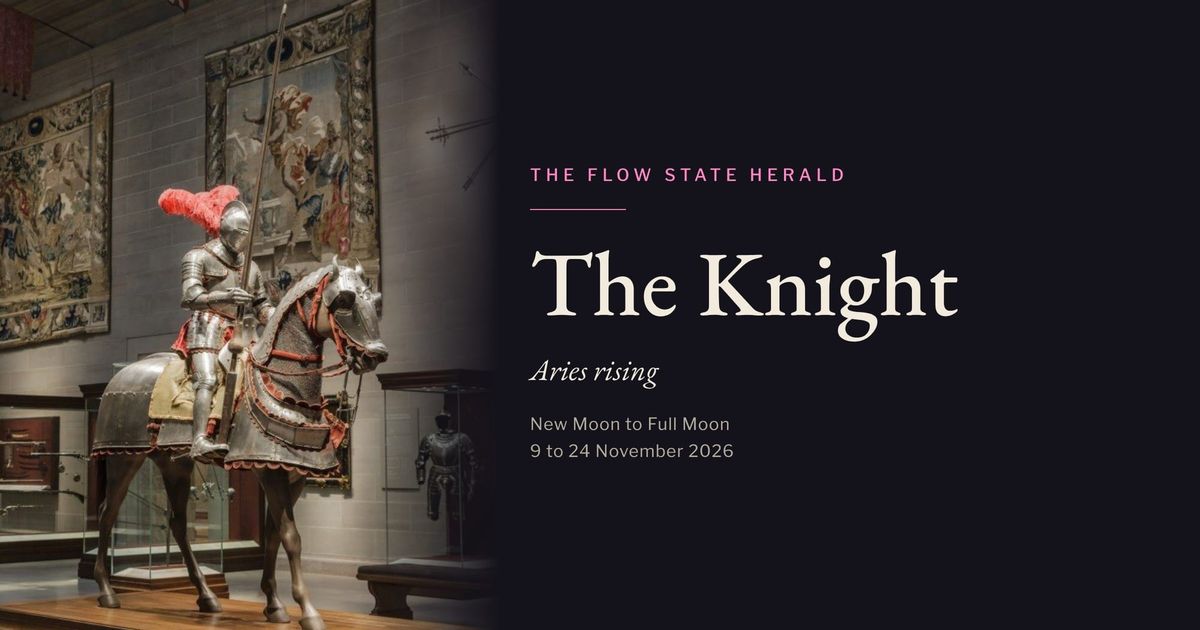
Aries rising, the Knight · New Moon to Full Moon, 9 to 24 November
The Flow State Herald
Rising Sign edition · Monday 9 to Tuesday 24 November 2026
9 Nov
24 Nov
The Knight's edition, for Aries rising

To strive, to seek, to find, and not to yield.
— Alfred, Lord Tennyson, "Ulysses", Poems (1842). Source
Your sky · Tarot · Museum object · Album · Why the signs no longer match the stars · Calendar

Mars meets Jupiter in your 5th house

Start where the energy is. Mars and Jupiter are conjunct, sharing the same degree, at 25°53' Leo at 1:24 am on Monday 16 November, in your 5th house: what you do because you want to, not because you must. The 5th is the house of play, performance and self-expression, and also of risk, since nothing there is guaranteed. Mars is your chart ruler, so this is your own energy being enlarged by Jupiter, the planet of scale. It is the kind of courage that has nothing to do with defence: a first public performance, a piece of work shown before it is finished, a game played properly rather than safely.
Six days earlier, on Tuesday 10 November at 1:48 am, Venus and Mars made a sextile, an easy 60-degree contact. Venus was still retrograde at 23°09' Libra, in your 7th house, and Mars was at 23°09' Leo, in your 5th.
Then the Sun comes in sideways. From your 8th house the Sun, at 26°04' Scorpio, squares Jupiter, at 26°04' Leo, on Wednesday 18 November at 4:39 am. The Sun, at 27°25' Scorpio, squares Mars, at 27°25' Leo, on Thursday 19 November at 12:49 pm. A square is a 90-degree angle, read as friction. The 8th house is the house of what is held in common: shared resources, trust, dependence, and what the people in a family, a group or an arrangement have agreed to carry for one another. Set beside a Mars and Jupiter conjunction, it puts a gift next to the question of who else has a claim on it. Scorpio and Leo are both fixed signs, so neither gives way quickly, and the square tests what you have tried against what you have only talked about.
A New Moon in the 8th, with Mercury turning

The lunation on Monday 9 November at 2:02 am falls at 16°53' Scorpio in your 8th house, the house of vulnerability, shared money and the obligations that bind people together, whether two of them, a family or a larger group. Mercury is still retrograde nearby at 6°52' Scorpio, so the first four days are about going back over something left unfinished: a message, a figure, an understanding about what is owed.
Mercury stations direct at 5°02' Scorpio on Friday 13 November at 10:54 am, and what has been circling can begin to settle. A Knight holds a position by knowing what is private and what is shared before acting on either. This is the part of the two weeks that asks you to protect something rather than start it.
Venus turns direct that evening at 7:28 pm, at 22°52' Libra. Her path is worth following, because it changes houses. She stationed retrograde on 3 October at 8°29' Scorpio, in your 8th house, where the review was about shared resources and trust. On 25 October she moved back into Libra and your 7th house, the house of the one-to-one agreement, and the review shifted to a particular relationship or arrangement. The turn on the 13th happens there, in the 7th.
The Full Moon in your 3rd house, and your own sign under pressure

On Friday 20 November the Moon passes over Neptune, at 1°45' Aries, at 4:03 am and over Saturn, at 8°18' Aries, at 3:44 pm. Both are retrograde, in your 1st house. Neptune loosens outlines and Saturn draws them, and it is a day for the old question of the Knight: is this courage or is it only speed? Conviction and certainty are not the same thing, and the first can act well in the absence of the second.
The Sun enters Sagittarius on Sunday 22 November at 2:23 am, in your 9th house of study and distance. Two days later the Full Moon arrives at 2°20' Gemini on Tuesday 24 November at 9:54 am in your 3rd house. Uranus, retrograde at 3°44' Gemini, is less than one and a half degrees from it, and the Moon reaches Uranus at 12:07 pm. The 3rd house is where speech turns into action: what you say to a neighbour, a sibling or a colleague can carry a small commitment, and a Knight's word is meant to be kept. Uranus, which astrology associates with breaks from habit, asks whether the way you usually speak is still how you wish to answer, and what you are prepared to be held to once it has been said.
Tarot
Tap a card to turn it over.
Self-reliance, refinement, earned comfort. The Nine of Pentacles is independence that has been built, not inherited: ease in the results of one's own patience. It is the opposite of the Knight's usual speed, a satisfaction that arrives only once the work is complete.
Pamela Colman Smith, Rider-Waite-Smith tarot, 1909. Drawn before the readings were written; the draw is on record.
Vitality, clarity, plain joy. The Sun is the simplest good in the major arcana: things seen as they are, in full light, with nothing hidden and nothing to manage. It is the card of the open season and of energy that needs no justification. For the Knight, it is courage without the armour.
Pamela Colman Smith, Rider-Waite-Smith tarot, 1909. Drawn before the readings were written; the draw is on record.
Turning point, cycle, timing. The Wheel of Fortune is the oldest image of change: what rises falls, what falls rises, and no position is permanent. It places the reading inside a larger rhythm instead of a personal success or failure. The two weeks between a New and a Full Moon make a small wheel of their own.
Pamela Colman Smith, Rider-Waite-Smith tarot, 1909. Drawn before the readings were written; the draw is on record.
Museum object
Double-sided pendant icon with the Virgin and Christ Pantokrator

This gold pendant is a little over three centimetres tall, about the size of a postage stamp, and the pictures on it are made of enamel. The Met's record dates it to about 1100 and calls it Byzantine: the Virgin on one side, Christ Pantokrator ("ruler of all") on the other.
The technique is cloisonné. Thin gold strips are bent into outlines and soldered upright onto a gold plate, and each tiny cell is filled with powdered glass and fired until it melts into colour. A face this small takes many cells, and every one of them is very narrow.
A pendant icon was worn, so the image travelled with its owner, close to the body. Look at how a full face and halo fit in a space smaller than a thumbnail, and how the gold wire does the drawing that a brush does on a panel.
Double-Sided Pendant Icon with the Virgin and Christ Pantokrator, ca. 1100, Byzantine, gold and cloisonné enamel. The Metropolitan Museum of Art. The Met
Album
The Raincoats, The Raincoats, 1979. Spotify · Source
The London band was formed in 1977 by art students Ana da Silva and Gina Birch, and this debut came out on Rough Trade. Violin and unpolished playing give it a sound no one else had. Kurt Cobain later wrote the liner notes for its 1993 reissue. The sound is angular and loose: violin and guitar that wander around the beat, and two voices that sing plainly without polish.
Why the signs no longer match the stars

Why do the signs of the zodiac no longer match the stars they were named for?
In the third century BCE, an astronomer called Timocharis, working in Alexandria, recorded the bright star Spica as eight degrees west of the autumn equinox, the point where the Sun crosses the celestial equator in September. Almost everything we know of him comes from Ptolemy, who cites his work in the Almagest (Wikipedia on Timocharis). Later, Hipparchus measured Spica again and found it six degrees away.
Hipparchus did not conclude that the star had wandered. Using older lunar eclipse records to date Timocharis's observation, he concluded that the measuring point itself was shifting against the stars. This is the precession of the equinoxes. The St Andrews biography says it grew out of his work on the exact length of the year.
How fast is it? The sources do not quite agree on what Hipparchus found. The Timocharis article gives a first estimate of at least one hundredth of a degree a year. The St Andrews biography gives 46 arcseconds a year, which it calls good against the modern value of 50.26, and says Ptolemy, nearly three centuries later, got 36. An arcsecond is a 3,600th of a degree. That page also says there is no agreement on many of the points it discusses, and it does not reconcile its own two figures.
The rest is this paper's own arithmetic. At 50.26 arcseconds a year, the equinox moves one degree in about 72 years, so crossing a 30 degree sign takes roughly 2,150 years. Signs are measured from the equinox, so they travel with it, while the constellations stay with the stars. That would be why the two have slid apart since the signs were named, and why some astrologers keep a separate zodiac fixed to the stars. That last step is a reading, not something either source states.
What is documented is the shift in Spica's position and Hipparchus's explanation of it. What is argued over is how large his figure was and who recorded which observation: the Timocharis article notes it is uncertain whether the earliest star measurements were his or his colleague Aristillus's.
Go further: Hipparchus of Rhodes, MacTutor biography
Calendar
Hindu, Tue 10 Nov: Bhai Dooj, when sisters feed their brothers and pray for their long life. In India it falls a day later, on Wed 11 Nov. Hindutone
Jewish, Tue 10 Nov: Rosh Chodesh Kislev, the first day of the month of Kislev, marked at the new moon. Ateret Yaakov
Hindu, Sun 15 Nov: Chhath Puja, four days of sun worship in Bihar, Jharkhand and eastern Uttar Pradesh, with the main offering made in the evening. Hindutone
Hindu, Fri 20 and Sat 21 Nov: Dev Uthani Ekadashi, when Vishnu is said to wake from four months of sleep, and the next day Tulsi Vivah, the ceremonial marriage of the tulsi plant to Vishnu. Hindutone
Hindu and Sikh, Tue 24 Nov: Kartik Purnima. Dev Diwali lights the ghats of Varanasi with lamps, and Sikhs celebrate the birth of Guru Nanak (on Mon 23 Nov in Alberta and British Columbia). Hindutone
Dates for you
- Mon 9 Nov, 2:02 am: New Moon in your 8th house
- Tue 10 Nov, 1:48 am: Venus sextile Mars
- Fri 13 Nov, 10:54 am: Mercury direct in your 8th house
- Fri 13 Nov, 7:28 pm: Venus direct in your 7th house
- Mon 16 Nov, 1:24 am: Mars conjunct Jupiter in your 5th house
- Wed 18 and Thu 19 Nov: the Sun squares Jupiter, then Mars
- Fri 20 Nov: the Moon over Neptune and Saturn in your sign
- Tue 24 Nov, 9:54 am: Full Moon in your 3rd house
A question to carry
What have you actually tried, as opposed to only discussed, and what would it cost you to defend it?
Box decorated with flowers and clouds, Korea, 18th century. Lacquer inlaid with mother-of-pearl, tortoiseshell, and brass wire. The Metropolitan Museum of Art, Gift of Florence and Herbert Irving, 2015. Museum page.
How this was made
Times are Eastern (ET). The sky is calculated with the Swiss Ephemeris. Pictures come from museum open access collections and are credited in each caption. For reflection and enjoyment, not medical, financial or legal advice.