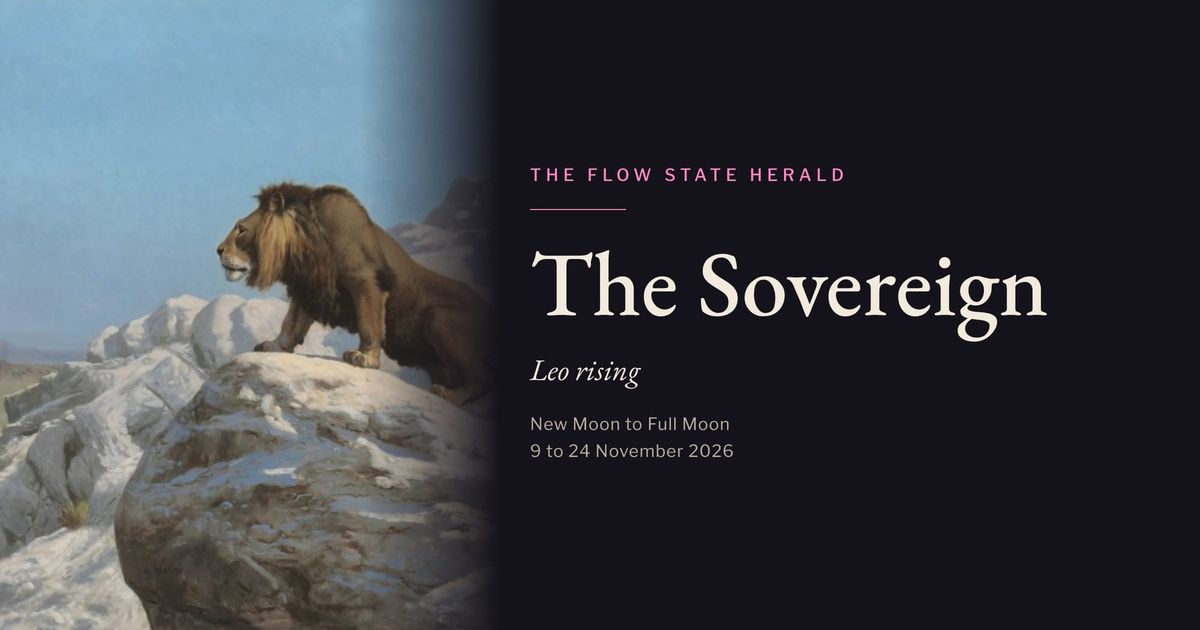
Leo rising, the Sovereign · New Moon to Full Moon, 9 to 24 November
The Flow State Herald
Rising Sign edition · Monday 9 to Tuesday 24 November 2026
9 Nov
24 Nov
The Sovereign's edition, for Leo rising

Uneasy lies the head that wears a crown.
— William Shakespeare, Henry IV, Part 2, Act 3, Scene 1. Source
Your sky · Tarot · Museum object · Album · What Magna Carta did, and for whom · Calendar

Mars and Jupiter in your 1st house

At 1:24 am on Monday 16 November Mars meets Jupiter, at 25°53' Leo. Both planets are in your rising sign, in the house of the body, the face you turn to people and the way you walk into a room. Mars is the planet of will and drive, Jupiter of scale and generosity, and in Leo, a fire sign, both are confident, warm and large. A Sovereign's warmth is as much a part of the office as its authority: affection freely given, a gift that asks nothing back, the capacity to play. You may feel more able to act and more willing to give than you have in weeks, and a conjunction like this makes you more visible to others. What they see can be bigger than you meant it to be, which is a question about dignity as much as about ambition: how much of a gesture belongs to the person making it, and how much to the people watching.
Authority that is large is also authority that is asked to answer. The First Quarter Moon, at 25°08' Aquarius, sits in your 7th house on Tuesday 17 November at 6:48 am, directly across the chart from your sign. It is opposite Jupiter, at 26°00' Leo, at 8:28 am, and opposite Mars, at 26°29' Leo, at 9:26 am. The 7th house holds the other person in the room: a partner, a collaborator, a rival or a critic. What the opposition raises is a fair question, what is this for, and the sky puts it on the same morning as the conjunction. An answer given in the open carries further than one given at a distance. Visibility brings a responsibility to explain, and it can be met with generosity rather than defence.
The Sun in the 4th house, squaring both

The New Moon on Monday 9 November at 2:02 am falls at 16°53' Scorpio in your 4th house, and the Sun, your chart ruler, stays there until 22 November. The 4th house is home, family, ancestry and the ground your life stands on. Mercury is retrograde at 6°52' Scorpio in the same house at the New Moon, so the first four days are about revisiting a family arrangement or a domestic decision that was left half-made. Mercury stations direct at 5°02' Scorpio on Friday 13 November at 10:54 am, and the matter has room to move.
Venus turns direct that evening at 7:28 pm, at 22°52' Libra, in your 3rd house of siblings, neighbours and everyday exchange. She stationed retrograde on 3 October at 8°29' Scorpio, in your 4th house, so the first three weeks of her review were about home. On 25 October she moved back into Libra and the 3rd house, and the review widened to the people nearest you and how you talk to them. The turn leaves that conversation a little easier to resume.
On Wednesday 18 November at 4:39 am the Sun, at 26°04' Scorpio, squares Jupiter, at 26°04' Leo. On Thursday 19 November at 12:49 pm the Sun, at 27°25' Scorpio, squares Mars, at 27°25' Leo. A square is a 90-degree angle, read as friction. Your ruler is squaring planets in your own sign from the house of home. That is a test of whether the generosity of the 16th reaches the people at the table, or only the people in the audience. Scorpio and Leo are fixed signs, so neither side moves for a flourish. It is a question about how a ruler behaves at home, and it is answered by what is done rather than by what is announced.
The Full Moon in the 11th, and the Sun into the 5th

On Friday 20 November the Moon crosses Neptune, at 1°45' Aries, at 4:03 am and Saturn, at 8°18' Aries, at 3:44 pm. Both are retrograde, in your 9th house of philosophy, principles and education. That is where a person asks what they hold to be true and why, and what they were taught compared with what they have come to believe. Neptune loosens received certainties and Saturn tests what is left, which suits a Sovereign reconsidering the principles behind how they rule and what they would want to pass on.
The Sun enters Sagittarius on Sunday 22 November at 2:23 am, in your 5th house of creative life, play, romance and children. This is a lighter turn: the stage is yours again, and the mood is playful. Play and affection are part of how a Sovereign governs, because they remind a court what it is for. Two days later the Full Moon, at 2°20' Gemini, falls at 9:54 am on Tuesday 24 November in your 11th house of friends, groups and hopes. Uranus, at 3°44' Gemini, is retrograde and less than one and a half degrees away, and the Moon reaches it at 12:07 pm. The 11th house is where a Sovereign's circle meets as equals, and it asks what you give to a group and what you expect to receive in return: patronage, belonging, or just recognition. Uranus, which astrology associates with independence from received arrangements, points to the part of a shared hope whose terms are not yours to set. The Sun's opposition to Uranus follows on Wednesday 25 November at 5:41 pm.
Tarot
Tap a card to turn it over.
Release, a loosened grip, honest naming. The Devil is attachment: the habit, appetite or bargain that feels like a necessity. Reversed, the grip loosens and what was taken for fate is seen as a choice. It is an inward unbinding, and it begins with naming the thing plainly.
Pamela Colman Smith, Rider-Waite-Smith tarot, 1909. Drawn before the readings were written; the draw is on record.
Misalignment, a divided choice, values out of step. The Lovers is the major card of choice, the decision where who one is and what one wants have to agree. Reversed, they do not yet agree, and the decision is deferred or made for the wrong reasons. For the Sovereign, with Mars and Jupiter meeting inside the sign on the 16th, the choice is one others will see.
Pamela Colman Smith, Rider-Waite-Smith tarot, 1909. Drawn before the readings were written; the draw is on record.
Stalemate, a closed mind, a decision held back. The Two of Swords is the refusal to choose, a balance kept by not looking at what the choice would cost. It protects for a time and it also keeps the matter from moving. Eventually the matter has to be faced.
Pamela Colman Smith, Rider-Waite-Smith tarot, 1909. Drawn before the readings were written; the draw is on record.
Museum object
Automaton clock in the form of a lion

This clock is made in the shape of a lion and stands on a dark wooden base. The Met's record names Karl Schmidt as the maker, dates it to about 1620 to 1635, and lists the materials as gilded brass and gilded silver on a dark wooden base, with a silvered brass dial and an iron and brass movement.
It is an automaton, a clock that does more than tell the time, and in the 1600s such pieces were luxury objects, made to be shown to guests at a court or in a collector's house. Look at how the lion stands over the dial: gilded metal catches the light in a way few materials do, and the animal that stands for the Sun keeps the time.
The Met's record places it in European Sculpture and Decorative Arts.
Karl Schmidt, Automaton clock in the form of a lion, ca. 1620 to 1635, gilded brass, gilded silver and wood. The Metropolitan Museum of Art. The Met
Album
They Say I'm Different, Betty Davis, 1974. Spotify · Source
Betty Davis wrote all the songs on her second album and produced it herself, and it was released in 1974 on Just Sunshine Records. She had been married to Miles Davis in 1968, and his name often comes up first. The record shows why it should not. It is funk: heavy bass and guitar riffs, a tight rhythm section, and her rasping, shouted vocals on top.
What Magna Carta did, and for whom

Did Magna Carta limit the king, and whom did it protect?
On 15 June 1215, at Runnymede meadow by the Thames, King John agreed to terms drawn up by rebel barons who had seized London. The Origins article from Ohio State calls it essentially a peace treaty, meant to protect the barons' feudal rights and curb abuses of royal power. It was annulled quickly by the pope, and England slid further into civil war.
The charter has 63 clauses, mixing complaints about John's own conduct with responses to the growth of royal administration over the twelfth century. Clauses 12 and 14 stopped the king from demanding certain feudal payments without consent, which the article links to later parliamentary control over taxation. Clause 39 says that no free man may be seized, imprisoned or stripped of his rights except by the lawful judgment of his peers or by the law of the land. History Today calls it the charter's best-known statement of principle and says it was meant to place the king under the law. The charter was confirmed in its definitive form by Henry III in 1225.
So did it limit the king? On paper, and in intent, yes, for the group that wrote it. But the document was written for the barons and the "free man" of 1215 was a small part of the population. Scholars still argue over whether it was conservative, a restatement of old rights, or revolutionary, and the Origins article says so openly.
What came afterward matters as much. English kings reissued it throughout the medieval period and it entered statute in 1297, but it was largely ignored for centuries. In the seventeenth century jurists revived it against the absolutism of the Stuart kings, as a guarantee of individual liberty and limited monarchy. American colonists read it as confirming their rights as English subjects, and later charters, including the 1948 Universal Declaration of Human Rights, are described as inheriting from it.
The paper's own reading: the clause that made history was not the one that mattered to the barons in 1215. A promise made by a king under pressure became a standard that later generations held other rulers to.
Go further: Magna Carta and its legacy, Origins (Ohio State University)
Calendar
Hindu, Tue 10 Nov: Bhai Dooj, when sisters feed their brothers and pray for their long life. In India it falls a day later, on Wed 11 Nov. Hindutone
Jewish, Tue 10 Nov: Rosh Chodesh Kislev, the first day of the month of Kislev, marked at the new moon. Ateret Yaakov
Hindu, Sun 15 Nov: Chhath Puja, four days of sun worship in Bihar, Jharkhand and eastern Uttar Pradesh, with the main offering made in the evening. Hindutone
Hindu, Fri 20 and Sat 21 Nov: Dev Uthani Ekadashi, when Vishnu is said to wake from four months of sleep, and the next day Tulsi Vivah, the ceremonial marriage of the tulsi plant to Vishnu. Hindutone
Hindu and Sikh, Tue 24 Nov: Kartik Purnima. Dev Diwali lights the ghats of Varanasi with lamps, and Sikhs celebrate the birth of Guru Nanak (on Mon 23 Nov in Alberta and British Columbia). Hindutone
Dates for you
- Mon 9 Nov, 2:02 am: New Moon in your 4th house
- Fri 13 Nov, 10:54 am: Mercury direct in your 4th house
- Fri 13 Nov, 7:28 pm: Venus direct in your 3rd house
- Mon 16 Nov, 1:24 am: Mars conjunct Jupiter in your 1st house
- Tue 17 Nov, 6:48 am: First Quarter Moon in your 7th house, opposing Jupiter and Mars within hours
- Wed 18 and Thu 19 Nov: the Sun squares Jupiter, then Mars
- Sun 22 Nov, 2:23 am: the Sun enters your 5th house
- Tue 24 Nov, 9:54 am: Full Moon in your 11th house, beside Uranus
A question to carry
When someone asks what all this is for, what is the answer that does not need an audience?
Box decorated with flowers and clouds, Korea, 18th century. Lacquer inlaid with mother-of-pearl, tortoiseshell, and brass wire. The Metropolitan Museum of Art, Gift of Florence and Herbert Irving, 2015. Museum page.
How this was made
Times are Eastern (ET). The sky is calculated with the Swiss Ephemeris. Pictures come from museum open access collections and are credited in each caption. For reflection and enjoyment, not medical, financial or legal advice.